

Step 1
Pre-Refractive Assessment - Eye scans, evaluation, consultation.
1
No Touch EPI-LASIK
At Eagle Eye Centre, Trans PRK (also known as No Touch EPI-LASIK) offers a safe and effective laser vision correction option for those who prefer a flap-free, blade-free treatment. Using advanced excimer laser technology, this procedure gently reshapes the cornea without any physical contact with the eye. It is especially suitable for patients with thinner corneas, active lifestyles, or those who wish to avoid potential flap-related risks.

Procedure time per eye
Average recovery time
Clearer vision results
Discomfort level
Trans PRK, also referred to as No Touch EPI-LASIK, is a bladeless, flap-free form of laser vision correction performed entirely using an excimer laser. Unlike traditional LASIK, this procedure does not require mechanical instruments or suction devices to touch the eye.
At Eagle Eye Centre, Trans PRK is performed using the Wavelight Allegretto Wave Eye-Q platform. This advanced laser system first removes the epithelium (the outermost layer of the cornea) and then reshapes the underlying corneal tissue to correct vision — all in a single-step, touch-free process.
Trans PRK, also referred to as No Touch EPI-LASIK, is a bladeless, flap-free form of laser vision correction performed entirely using an excimer laser. Unlike traditional LASIK, this procedure does not require mechanical instruments or suction devices to touch the eye.
At Eagle Eye Centre, Trans PRK is performed using the Wavelight Allegretto Wave Eye-Q platform. This advanced laser system first removes the epithelium (the outermost layer of the cornea) and then reshapes the underlying corneal tissue to correct vision — all in a single-step, touch-free process.
Wavelight Allegretto Wave Eye-Q (Excimer laser)
No flap, no blade, all-laser surface ablation
No physical instruments contact the cornea
Thin corneas, active lifestyles, contact sports, and flap-related complication risks
Functional vision typically within 1–3 weeks
1–2 days post-procedure
Temporary bandage contact lens and follow-up reviews
Trans PRK is an effective laser vision correction technique that treats a wide range of common refractive errors by reshaping the cornea with precision. It is especially suitable for patients who may not qualify for LASIK due to corneal thickness or other considerations.
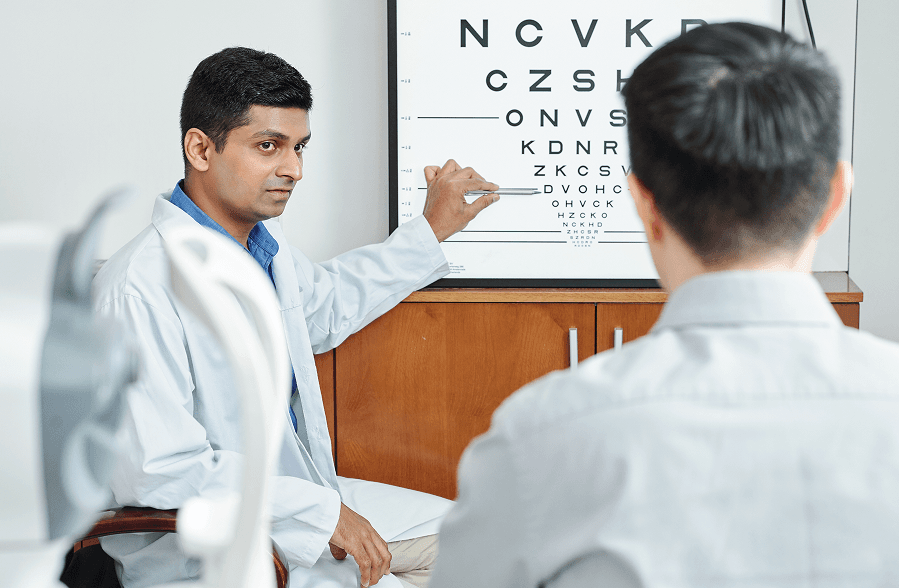
Individuals with myopia see nearby objects clearly, but distant objects appear blurry. Trans PRK adjusts the curvature of the cornea to allow light to focus accurately on the retina, improving distance vision.
Pre-Refractive Assessment - Eye scans, evaluation, consultation.
Surgery Day - Eye preparation, laser correction.
Recovery - Brief rest, medication provided.
Follow-Up Care - Reviews on Day 1, Week 1, Month 1, and as advised.
Pre-Refractive Assessment - Eye scans, evaluation, consultation.

Surgery Day - Eye preparation, laser correction.

Recovery - Brief rest, medication provided.

Follow-Up Care - Reviews on Day 1, Week 1, Month 1, and as advised.

Your suitability will be assessed during a comprehensive pre-surgery consultation, including corneal mapping and ocular health evaluation.
Full recovery after Trans PRK can take up to 3 months, depending on individual healing response. Strict adherence to your post-operative care plan, including eye drops and follow-up visits, plays a key role in achieving optimal results.

You may experience some discomfort, blurred vision, light sensitivity, and mild tearing. Halos or glare around lights can also occur.
Vision gradually begins to improve. Many patients are able to resume light daily activities, though vision may still fluctuate.
Most initial side effects such as dryness, halos, or glare begin to subside. Vision stabilisation continues, and daily function becomes easier.
By this stage, most patients achieve their expected visual outcomes. Glare and halos are usually minimal or resolved. Dryness, if present, typically improves significantly.
You may experience some discomfort, blurred vision, light sensitivity, and mild tearing. Halos or glare around lights can also occur.
Vision gradually begins to improve. Many patients are able to resume light daily activities, though vision may still fluctuate.
Most initial side effects such as dryness, halos, or glare begin to subside. Vision stabilisation continues, and daily function becomes easier.
By this stage, most patients achieve their expected visual outcomes. Glare and halos are usually minimal or resolved. Dryness, if present, typically improves significantly.
Ask us anything about how we can help you understand eye care better!
Schedule an eye check up
If you're exploring LASIK to correct your vision, the team at Eagle Eye Centre is here to help. Our experienced eye specialists will guide you through a comprehensive consultation to assess your suitability and explain the available treatment options.
If Trans PRK is not the best fit for your eyes, we will recommend a safe and effective alternative tailored to your visual needs.
At Eagle Eye Centre, our doctors are committed to providing quality care with a focus on safety, precision, and patient comfort. With years of clinical experience, our team is well-equipped to manage both simple and complex eye conditions, ensuring you receive personalised and holistic care at every step.