
Femto LASIK vs SMILE
Written by Eagle Eye Centre
Published on November 2, 2026
Refractive errors, including myopia(short-sightedness), hyperopia(long-sightedness) and astigmatism, are common vision problems. In Singapore, where myopia is widespread, many people begin wearing glasses during their school years. Without appropriate correction, refractive errors can cause blurred vision, difficulty reading, eye strain and sometimes headaches, affecting work, study and everyday activities.
Adults whose vision has stabilised and who hold a valid prescription may choose laser vision correction surgery, provided their eyes meet the necessary criteria. At Eagle Eye Centre, we conduct a comprehensive pre-operative assessment to work with patients in determining the most suitable surgical plan, which primarily includes Femtosecond LASIK and SMILE. Whilst the technical approaches of these two procedures differ, they both work on the principle of reshaping the cornea to correct refractive errors, helping patients reduce their reliance on spectacles and contact lenses.
Understanding Femto LASIK
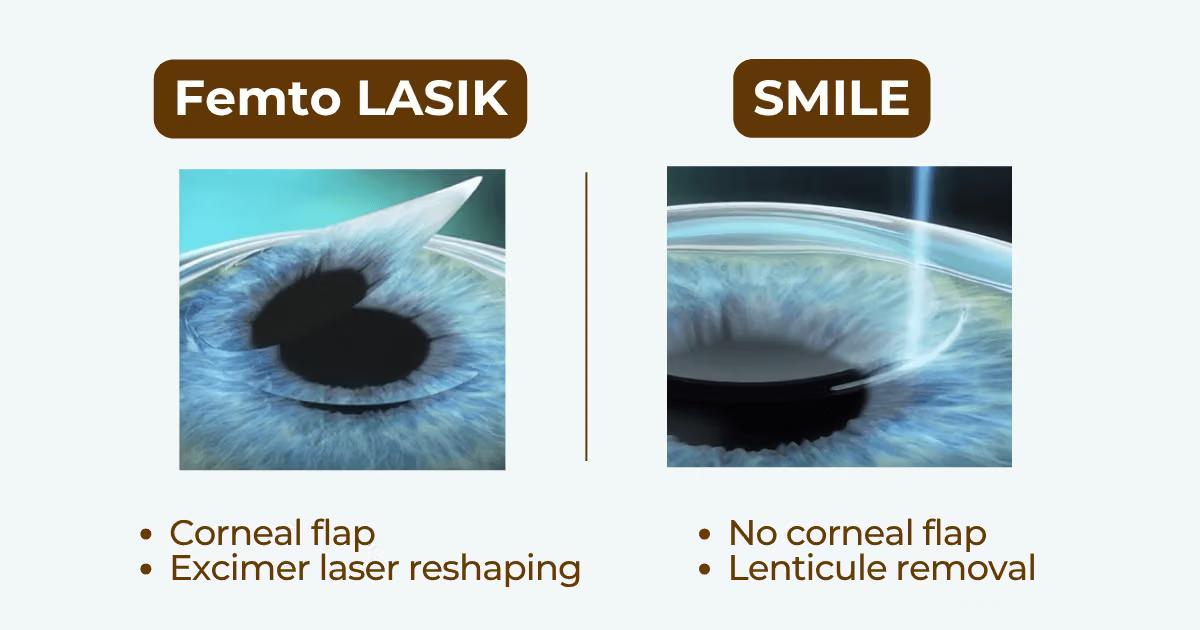
Femto LASIK, also known as bladeless LASIK, is a laser vision correction procedure that reshapes the cornea to correct refractive errors. The cornea is the clear front surface of the eye that helps focus light. During the procedure, a femtosecond laser creates a thin corneal flap. An excimer laser then reshapes the tissue beneath it before the flap is repositioned.
“Bladeless” means that a laser is used instead of a mechanical blade to create the flap. Femto LASIK still involves a corneal flap, so a thorough pre-operative assessment and careful protection of your eyes during recovery remain important.
What can Femto LASIK correct?
Femto LASIK can correct the following refractive errors:
- Short-sightedness (myopia): Distant objects appear blurred, such as a classroom whiteboard or road signs.
- Long-sightedness (hyperopia): Reading and other close-up tasks may require more effort. Higher degrees of hyperopia can affect both near and distance vision.
- Astigmatism: Objects may appear blurred or distorted at different distances.
The treatment range varies according to the laser platform and your individual eye measurements. Your ophthalmologist will consider your prescription, corneal thickness and shape, and overall eye health when assessing whether the procedure is suitable for you.
Who may be suitable for Femto LASIK?
Suitability depends on more than your prescription. At Eagle Eye Centre, our ophthalmologists assess several factors during your pre-operative examination:
- Age and prescription stability: You should generally be at least 18 years old and have a stable prescription. Your doctor will usually review prescription records from the past year or longer, rather than relying on a single measurement.
- Corneal thickness and shape: Your cornea needs sufficient thickness and a suitable shape. Thin corneas or conditions such as keratoconus may mean that another approach is more appropriate.
- Eye surface and overall eye health: Significant dry eye, infection or active inflammation require assessment and treatment before surgery is considered. Other eye conditions may also affect your options.
- General health and medications: Tell your doctor about your medical history and any medications you take. Surgery is generally postponed during pregnancy or breastfeeding, when prescriptions may fluctuate, with suitability reassessed once vision has stabilised.
- Lifestyle and expectations: If you participate in contact sports or have a job that carries a risk of eye injury, discuss this during your consultation so it can be considered when selecting a procedure.
These factors guide the assessment. Your doctor’s recommendation will depend on the full examination findings.
Potential benefits of Femto LASIK
For suitable patients, the potential benefits include:
- Reduced dependence on glasses or contact lenses: Correcting refractive errors can improve vision without glasses, although individual results vary.
- Treatment of different refractive errors: Femto LASIK can address myopia, hyperopia and astigmatism within the limits of the equipment and your eye measurements.
- Relatively quick initial visual improvement: Many patients notice clearer vision within one to two days, although this does not mean their vision has fully stabilised.
- Treatment planned around your eyes: Your prescription and corneal measurements are used to plan the laser treatment.
It is also important to understand the limitations. Femto LASIK can cause dry eye, glare, halos, residual refractive error or flap-related complications, and some symptoms may persist. Surgery does not guarantee that you will never need glasses again. For example, reading glasses may still be needed as age-related near-vision changes, known as presbyopia, develop.
What can you expect during recovery?
The first few hours
Your eyes may water or feel gritty, and you may experience light sensitivity or blurred vision. Mild discomfort can occur as the anaesthetic drops wear off. Rest and use your prescribed drops as directed, avoid rubbing your eyes, and arrange for someone to accompany you home. Do not drive on the day of surgery.
Returning to everyday activities
Many patients notice an improvement in vision within one to two days. However, when you can return to work or study depends on your vision, eye comfort and the demands of your activities.
Being able to read comfortably does not necessarily mean you are ready for night driving, swimming or contact sports. Resume these activities according to your doctor’s advice.
Follow-up care and vision stabilisation
Returning to everyday activities and achieving stable vision are different stages of recovery. Vision may fluctuate initially and can take several weeks to months to stabilise.
Continue using prescribed eye drops and lubricating drops as advised. Avoid rubbing your eyes and protect them from accidental knocks.
Follow-up appointments are typically scheduled for the first day, first week and first month after surgery, with adjustments according to your recovery. Your doctor will check the corneal flap, eye surface and vision, and adjust your care plan if needed.
If you develop significant pain, a sudden decrease in vision or worsening symptoms, contact your ophthalmologist promptly rather than waiting for your next appointment.
Understanding SMILE
SMILE stands for small incision lenticule extraction. It is a laser vision correction procedure that reshapes the cornea to help light focus more accurately on the retina and reduce dependence on glasses or contact lenses.
A femtosecond laser creates a thin disc of tissue within the cornea, called a lenticule. The surgeon then removes it through a small incision. This lenticule is made from your own corneal tissue; it is not an artificial lens implanted in the eye. SMILE does not involve creating or lifting a corneal flap, and no excimer laser is needed to reshape the cornea.
What can SMILE correct?
Conventional SMILE is mainly used to correct the following refractive errors:
- Myopia (short-sightedness): Distant objects appear blurred, such as road signs, classroom whiteboards or presentation screens.
- Astigmatism: which can cause blurred or distorted vision at different distances, sometimes with ghost images.
The prescription range that can be treated depends on the laser platform, corneal thickness and shape, and the findings of your pre-operative assessment. A prescription within the equipment’s treatment range does not automatically mean that your cornea is suitable for surgery.
SMILE pro uses the same lenticule extraction approach with a newer laser platform. In some markets, it is also approved to treat long-sightedness (hyperopia) and associated astigmatism. These indications do not apply to every SMILE procedure. The available treatments and prescription limits depend on local approvals and the treatment options offered by the clinic.
How is SMILE performed?
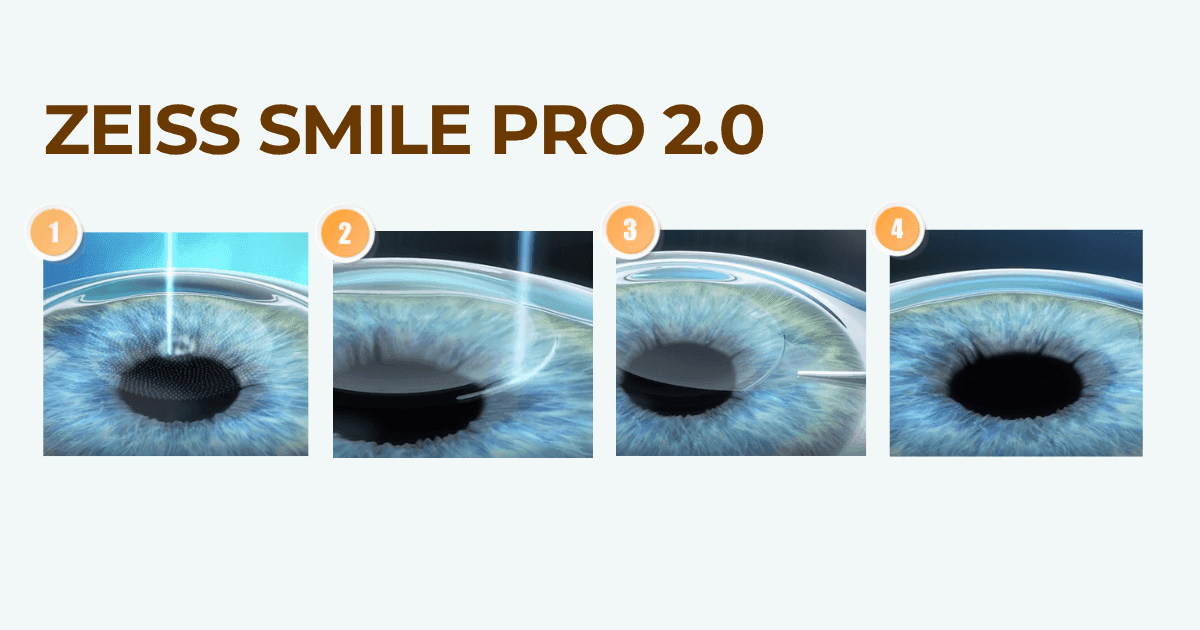
The procedure usually involves:
- Step one: Anaesthetic eye drops and an eyelid holder to prepare the eye.
- Step two: Suction through a contact interface to keep the eye in position.
- Step three: A femtosecond laser to create the lenticule and a small access incision.
- Step four: Removal of the lenticule by the surgeon through the incision.
The surface epithelium remains largely intact, and no LASIK-style flap is lifted. Eye drops and follow-up reviews support recovery.
Who may be suitable for SMILE?
Suitability depends on your prescription, corneal measurements and overall health. At Eagle Eye Centre, our ophthalmologists assess several factors before recommending treatment:
- Age and prescription stability: You should generally be at least 18 years old and have a stable prescription. Your doctor will usually review prescription records covering at least the past year to check for significant changes. The assessment period may vary according to your circumstances.
- Prescription and corneal measurements: Your degree of myopia and astigmatism, corneal thickness and corneal shape all need to be assessed. A flapless procedure does not automatically make SMILE suitable for thin or irregular corneas.
- Eye surface and overall eye health: Significant dry eye, infection, active inflammation or other eye conditions may affect your options and need to be assessed and managed first.
- General health and medications: Tell your doctor about your medical history and any medications you take, as these may affect your eyes or healing. Surgery is generally postponed during pregnancy or breastfeeding, with suitability reassessed once your condition and vision have stabilised.
- Previous eye surgery: If you have had LASIK, PRK or another corneal procedure, tell your doctor during the consultation. Previous surgery may make conventional SMILE unsuitable and requires a separate assessment of your treatment history and current corneal condition.
You should also mention any contact sports or work activities that carry a risk of eye injury, so your doctor can consider these when discussing your options.
Femto LASIK vs SMILE: Key Differences
Which procedure may be suitable for your eyes?
Choosing between Femto LASIK and SMILE begins with a detailed eye assessment. At Eagle Eye Centre, our ophthalmologists consider your prescription, corneal measurements, eye health and lifestyle before discussing suitable treatment options.
Your prescription and corneal measurements
Your ophthalmologist will check your prescription and whether it has remained stable, then assess your cornea’s thickness and shape. They will also calculate how much tissue the planned procedure would remove and how much supporting tissue would remain.
These findings help assess whether treatment is appropriate for your eyes. Having a prescription within a procedure’s treatment range does not automatically establish suitability. Corneal thickness, shape and the proposed treatment must be considered together, including for flapless procedures such as SMILE.
Your eye health and dry eye symptoms
Your doctor will examine your tear film, eyelids and eye surface, and ask about symptoms such as dryness, irritation or fluctuating vision. An unstable tear film can affect pre-operative measurements, while existing dry eye may affect comfort after surgery. Treatment may therefore be needed before measurements are repeated and suitability is reassessed.
Although some patients experience fewer early dry eye symptoms after SMILE than after LASIK, dryness can still occur. SMILE should therefore not be assumed to be suitable simply because you already have dry eyes. Other eye conditions, your medical history and medications also form part of the assessment.
Your lifestyle and recovery needs
Tell your ophthalmologist about your screen use, night driving and exercise habits. Visual fluctuations, dryness, glare or halos during recovery may affect work and driving, particularly in low light. If you participate in contact sports, the absence of a corneal flap may be a reason to discuss SMILE, provided your eye measurements are suitable.
You will also need time for rest, eye drops and follow-up appointments. Returning to work or study may be possible before your vision has fully stabilised. Your doctor can advise when to resume driving, swimming and other activities based on your recovery.
What if neither procedure is suitable?
Depending on your assessment, your ophthalmologist may discuss other options:
- PRK or Trans PRK: These surface laser procedures reshape the cornea without creating a flap. They may suit selected patients, but still require sufficient healthy corneal tissue and generally involve a longer initial recovery.
- Implantable collamer lens (ICL): A lens is implanted inside the eye while the natural lens remains in place. This corrects vision without removing corneal tissue, but requires a separate assessment of the eye’s internal anatomy and the procedure’s risks.
Glasses or contact lenses: These remain options if surgery is unsuitable or you prefer to continue with non-surgical vision correction.
Frequently asked questions
Is Femto LASIK or SMILE painful?
Both procedures use anaesthetic eye drops, so most patients experience little pain during surgery. Brief pressure or discomfort may occur, and mild stinging, watering or a gritty sensation can follow. Contact your ophthalmologist promptly if pain is severe or worsening.
Can I have either procedure if I already have dry eyes?
Possibly, but your doctor needs to assess the cause and severity of your dry eye and examine the eye surface. Treatment may be needed before suitability is reassessed. SMILE may cause fewer early dry eye symptoms in some patients, but dryness can still occur. Significant, poorly controlled dry eye may make either procedure unsuitable.
When can I return to work, drive or exercise?
- Work or study: Some patients return to desk-based work within one to two days, depending on vision, eye comfort and job demands.
- Driving: Do not drive on the day of surgery. Resume when your doctor confirms your vision is adequate, particularly if you experience glare or halos at night.
- Exercise: Restart gradually as advised. Swimming and contact sports generally require a longer break than light activities.
Will I still need glasses after surgery?
Possibly. Both procedures aim to reduce dependence on glasses, but complete freedom from them is not guaranteed. A residual prescription may mean you still need glasses for certain tasks. Reading glasses may also be needed later because surgery does not prevent presbyopia, the age-related loss of near focusing.
Can my prescription change after the procedure?
Yes. Surgery permanently reshapes the cornea, but your eyes can continue to change, and a prescription may return over time. Early blurred or fluctuating vision may instead relate to healing or dry eye. Your ophthalmologist should check the cause before further correction is considered.
What happens if further vision correction is needed?
Your doctor will first identify why your vision is reduced. Following assessment, options may include glasses, appropriately fitted contact lenses or enhancement surgery. Further surgery requires a stable prescription and an assessment of the remaining corneal tissue and eye health. After SMILE, enhancement may involve PRK or a LASIK-based technique. The approach may differ from your original procedure and is not suitable for everyone.
How is SMILE different from SMILE pro?
Both remove a corneal lenticule through a small incision without creating a flap. SMILE pro uses the newer ZEISS VISUMAX 800 platform, with a shorter laser treatment phase and computer-assisted positioning and alignment. These updates do not guarantee faster recovery or better vision for every patient.
Explore your vision correction options
Considering Femto LASIK or SMILE? Schedule a refractive assessment at Eagle Eye Centre. Your ophthalmologist will review your prescription, corneal measurements and eye health, then discuss suitable options, potential risks and expected recovery.